Wards teaching was probably one of my favorite experiences of teaching as a resident. While it was different in my surgical intern year than as a pediatric resident, I first gained experience with a sepsis lecture I like to give.
As you may know from my first blog post, I first really learned the Surviving Sepsis Guidelines as a surgical intern, on day two of nights at the community hospital, and realized that these could be distilled into a few things.
- Recognizing sepsis,
- and treating it, under the tenets of 1) fluid resuscitation, 2) antitbiosis, and 3) source control.
Thus was born my first chalk talk. I proudly gave it to every. single. third year. medical student I came in contact with, and I thought it was great!
I continued to give it as a pediatric intern, but I realized I had never actually *asked* my learners what they thought of my lecture.
In fact, I had never really asked them what they thought of my teaching at all.
Thankfully, Children’s National had a great culture of feedback, and when I became a senior resident, I tried hard to elicit honest feedback each week (so that it was timely). They also rated senior residents in a formal way, and I was able to obtain that feedback later.

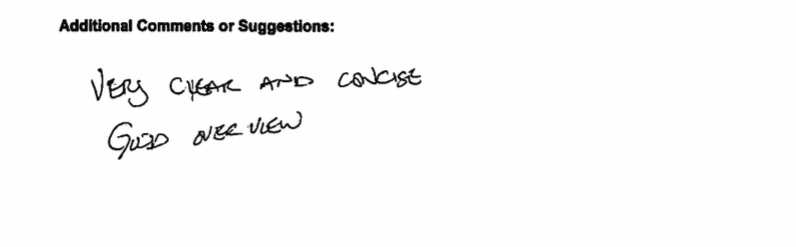
This was feedback provided on a chalk talk that I did on metabolism; the same talk that I reflected on in my first blog post.
More formal feedback from the medical students was given to me when I was the senior resident of a wards team:
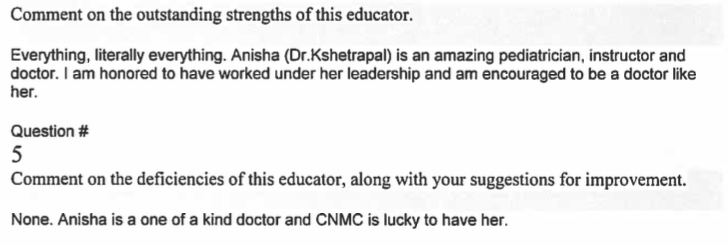
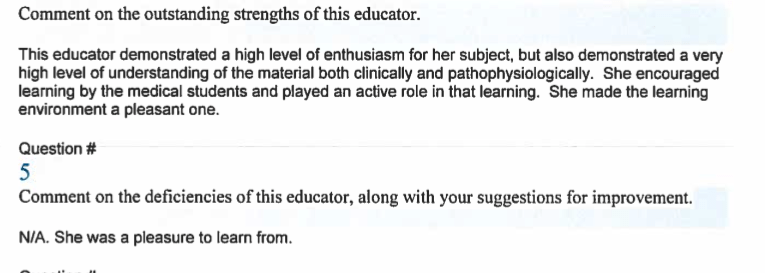
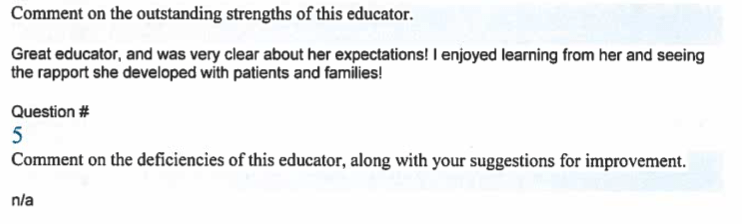
While this was all quite flattering, I also received some not so positive feedback. If I’m honest, I remember thinking: really? This is how they describe me? I still (years later) feel a rush of shame when I see this feedback:

Whoa. Not engaged, distracted, uninterested, a lack of respect? Even when I got this feedback, I racked my brain to imagine what exact behaviors I was getting feedback for. Was I being insensitive? Demanding? What exactly had caused two students to see me this way?
Unfortunately, the feedback wasn’t given to me directly, or in a timely way, so I wasn’t sure how to act on it. I would have loved to have a discussion with a student dissatisfied with my leadership on the team to tell me: hey, you messed up. We didn’t feel heard or like important members of the team. And while that would have been a difficult discussion, I would have loved to know what I could have done better.
 Anisha Kshetrapal, MD, MSEd